
Convert USDC to USD: Real-Time Rate, Fees & Best Way to Cash Out

When you search for "USDC to USD," you are likely looking for two key pieces of information: the current exchange rate between the stablecoin USD Coin and the U.S. dollar, or the practical process of converting your USDC holdings into actual fiat currency. Understanding this distinction is critical for making informed financial decisions in the crypto space.
First, let us address the exchange rate. USDC is a regulated stablecoin issued by Circle, designed to maintain a 1:1 peg with the U.S. dollar. This means that in a perfect market environment, 1 USDC should always equal 1 USD. However, in practice, you may see slight deviations on decentralized exchanges or during periods of extreme market volatility. These minor fluctuations usually resolve quickly through arbitrage. Therefore, if you are checking the price for accounting purposes or to assess the value of your portfolio, you can confidently assume that 1 USDC is worth 1 USD, minus any transaction fees.
The more complex and operationally important aspect of your query is the conversion process. "Cashing out" USDC to USD is not a single-step transaction like a direct swap on a centralized exchange. You typically need to go through a fiat on-ramp or off-ramp service. The most common method is using a centralized exchange such as Coinbase, Binance, or Kraken. On these platforms, you can sell your USDC for USD, which then becomes a fiat balance in your account. From there, you can withdraw the USD to your linked bank account via ACH transfer (in the U.S.) or wire transfer. The speed of this process varies: ACH transfers typically take 1-3 business days, while wire transfers can be faster but often incur higher fees.
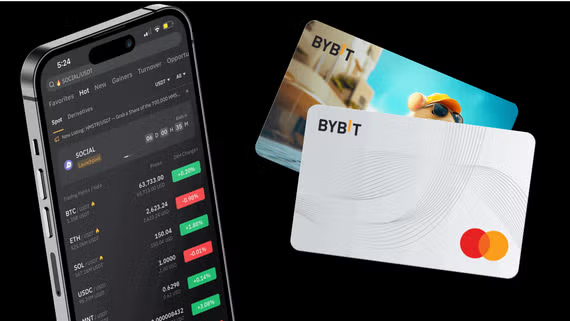
An alternative, and increasingly popular, method is using a crypto debit card. Services like the Coinbase Card or Crypto.com Visa allow you to spend your USDC directly at any merchant that accepts Visa or Mastercard. The card issuer automatically converts your USDC to USD at the point of sale. This bypasses the need to withdraw to a bank account, offering instant liquidity. However, you should be aware of potential spending limits and conversion fees, which can range from 0% to 2.5% depending on the card provider.
For peer-to-peer (P2P) transactions, platforms like Binance P2P allow you to sell USDC directly to another individual in exchange for USD deposited into your bank account. This method often offers better rates and faster settlement times, but it carries a higher risk of fraud. Always use an escrow service provided by the platform and verify the buyer's reputation before proceeding.
Finally, be mindful of fees. While the exchange rate is pegged, you will encounter network fees (gas fees) for sending USDC on the blockchain, trading fees on the exchange, and withdrawal fees for moving USD to your bank. Ethereum-based USDC transactions can have high gas fees during network congestion, while USDC on Solana or Polygon offers significantly lower costs. To maximize your conversion, choose a network with low fees and a platform that offers zero-fee trading for stablecoin pairs, such as Coinbase Advanced Trade or Kraken Pro.
In summary, converting USDC to USD is straightforward for the rate (1:1) but requires careful planning regarding the withdrawal method. For small, regular conversions, a crypto debit card is most convenient. For large sums, a centralized exchange with a bank transfer is the most secure and cost-effective route. Always compare the total cost, including network and withdrawal fees, before initiating the transaction.


发表评论